
Sunday, February 10, 2013
Wagner


Saturday, February 9, 2013
Ironic Distance
 What I like about great operas is their ironic distance to life. Theater should never try to be naturalistic because it is by definition a play, and musical theater takes us into a fairy world where people sing instead of talking. Opera at its best tells comic or tragic stories playfully, that is with a loving smile. This is very true of all operas Mozart composed. His music makes fun of the story's characters, in a good-natured, understanding way. Also, Verdi's and Puccini's tragic arias heighten rage, despair and heartache far above ugly reality, turning the expression of those feelings into an invisible description of human weakness to which we can knowingly give a nod. When I mentioned this observation to an opera buff some time ago he was taken aback, almost offended. Most probably he was a Wagnerian.
Friday, February 8, 2013
Thank you, Al!
 Not long ago, Al Pacino was Inside the Actors' Studio where he gave a wonderful interview. With respect to the large variety of roles he has played, he said: "You're as good as the chances you take". That is a proud and self-assured sentence, and it made me thinking. All creative people - and aren't we all creative people? - should expand their range, constantly trying to do new and daring things. Anything less is no challenge, and if you are not challenged, you're really not at your best. There is of course always the risk to fail. Even the best of us reach limits. Finding out where those limits are is one of the reasons we take chances. If we're afraid to fail we don't deserve to be talented. Better to fail trying something new than keep on following those worn-out paths. Regarding my own work: Maybe the musical in general doesn't need innovation, but I need to change the style and themes of my musicals or I betray myself.
Thursday, February 7, 2013
What's Next, Michael?

Wednesday, February 6, 2013
Fate Doesn't Make House Calls
 Roswitha currently enjoys reading The Prisoner of Heaven by Carlos Ruiz Zafón. She came across a place in that book which she liked so much that she read it to me. "Fate,"Zafón writes, "does not make house calls; you have to go see it." What a great sentence. While it is true that fate often drops by very unexpectedly, you can't call it to your door. If you wish to change your life you'd better start moving your ass to get out of your comfort zone.
Tuesday, February 5, 2013
The Very First Movie
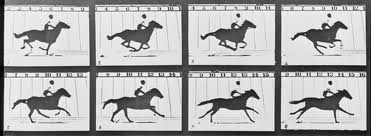
 Have you ever heard of Eadweard Muybridge? I hadn't until I read the NYT Review of a new non-fiction book by Edward Ball ("The Inventor and the Tycoon"). I've learned that Muybridge was, mildly put, an eccentric genius. He was also an inventor, a photographer and a murderer. His patron was Leland Stanford, an American railroad tycoon, best remembered today for founding the Stanford University. Stanford loved horses. He wanted to know how they run, and in 1872 he turned to Muybridge to find a way to photograph their movement. It took the ingenious man a year until he found out how to do it. His "serial photographs" of galloping horses, shot by 12 cameras, proved that horses lift all four feet as they run. Muybridge also found a way to project the photographs onto a screen through a machine he called a zoopraxiscope. When the lighted photographes appeared in quick secession, Mr. Stanford was the first one to see a movie. The image seemed to gallop. That was the very beginning of the history of film.
Monday, February 4, 2013
Hitch 2 (To Be Continued)

“Everybody does have a book in them, but in most cases that’s where it should stay.”
Christopher Hitchens
Sunday, February 3, 2013
The Great Bellow
Every now and then I will use this blog to introduce some of my heroes. Two days ago I presented Harold Prince who was and still is the mentor of my work as a creator of musicals. With him I had a lot of discussions, we worked together and met socially. It seems odd that I should feel a similar closeness to other people who I admire but never met in person. One of them is Saul Bellow. His Herzog I read like a report about my inner life. Bellows writing touches me like only certain pieces of music do. Nevertheless he was one of those theoreticians to whom, as he writes in Herzog, "one must show the door".


That said, you may want to read what Bellow says about the change in literature of which he is an important part. I found this the other day in the Paris Review: "For a long time, perhaps from the middle of the nineteenth century, writers have not been satisfied to regard themselves simply as writers. They have required also a theoretical framework. Most often they have been their own theoreticians, have created their own ground as artists, and have provided an exegesis for their own works. They have found it necessary to take a position, not merely to write novels. In bed last night I was reading a collection of articles by Stendhal. One of them amused me very much, touched me. Stendhal was saying how lucky writers were in the age of Louis XIV not to have anyone take them very seriously. Their obscurity was very valuable. Corneille had been dead for several days before anyone at court considered the fact important enough to mention. In the nineteenth century, says Stendhal, there would have been several public orations, Corneille's funeral covered by all the papers. There are great advantages in not being taken tooseriously. Some writers are excessively serious about themselves. They accept the ideas of the “cultivated public.” There is such a thing as overcapitalizing the A in artist. Certain writers and musicians understand this. Stravinsky says the composer should practice his trade exactly as a shoemaker does. Mozart and Haydn accepted commissions—wrote to order. In the nineteenth century, the artist loftily waited for Inspiration. Once you elevate yourself to the rank of a cultural institution, you're in for a lot of trouble."
Saturday, February 2, 2013
Mara

Friday, February 1, 2013
Go To Hal!

Subscribe to:
Posts (Atom)