Tuesday, February 5, 2013

The Very First Movie

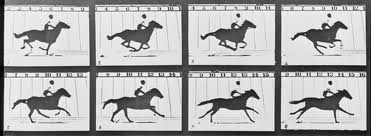
Have you ever heard of Eadweard Muybridge? I hadn't until I read the NYT Review of a new non-fiction book by Edward Ball ("The Inventor and the Tycoon"). I've learned that Muybridge was, mildly put, an eccentric genius. He was also an inventor, a photographer and a murderer. His patron was Leland Stanford, an American railroad tycoon, best remembered today for founding the Stanford University. Stanford loved horses. He wanted to know how they run, and in 1872 he turned to Muybridge to find a way to photograph their movement. It took the ingenious man a year until he found out how to do it. His "serial photographs" of galloping horses, shot by 12 cameras, proved that horses lift all four feet as they run. Muybridge also found a way to project the photographs onto a screen through a machine he called a zoopraxiscope. When the lighted photographes appeared in quick secession, Mr. Stanford was the first one to see a movie. The image seemed to gallop. That was the very beginning of the history of film.

Monday, February 4, 2013

Hitch 2 (To Be Continued)


“Everybody does have a book in them, but in most cases that’s where it should stay.”
Christopher Hitchens

Sunday, February 3, 2013

The Great Bellow

Every now and then I will use this blog to introduce some of my heroes. Two days ago I presented Harold Prince who was and still is the mentor of my work as a creator of musicals. With him I had a lot of discussions, we worked together and met socially. It seems odd that I should feel a similar closeness to other people who I admire but never met in person. One of them is Saul Bellow. His Herzog I read like a report about my inner life. Bellows writing touches me like only certain pieces of music do. Nevertheless he was one of those theoreticians to whom, as he writes in Herzog, "one must show the door".


That said, you may want to read what Bellow says about the change in literature of which he is an important part. I found this the other day in the Paris Review: "For a long time, perhaps from the middle of the nineteenth century, writers have not been satisfied to regard themselves simply as writers. They have required also a theoretical framework. Most often they have been their own theoreticians, have created their own ground as artists, and have provided an exegesis for their own works. They have found it necessary to take a position, not merely to write novels. In bed last night I was reading a collection of articles by Stendhal. One of them amused me very much, touched me. Stendhal was saying how lucky writers were in the age of Louis XIV not to have anyone take them very seriously. Their obscurity was very valuable. Corneille had been dead for several days before anyone at court considered the fact important enough to mention. In the nineteenth century, says Stendhal, there would have been several public orations, Corneille's funeral covered by all the papers. There are great advantages in not being taken tooseriously. Some writers are excessively serious about themselves. They accept the ideas of the “cultivated public.” There is such a thing as overcapitalizing the A in artist. Certain writers and musicians understand this. Stravinsky says the composer should practice his trade exactly as a shoemaker does. Mozart and Haydn accepted commissions—wrote to order. In the nineteenth century, the artist loftily waited for Inspiration. Once you elevate yourself to the rank of a cultural institution, you're in for a lot of trouble."

Saturday, February 2, 2013

Mara

I remember the 1970's as a time of unlimited possibilities. I had finished my studies, quitted a legal career and started to work as a pop lyricist and record producer in Munich. The city was vibrating with life, the air was filled with music and opportunity waited at every corner. My hairdresser was a young woman who owned a shop named MCM. The acronym stood for Modern Coiffeur Munich and at the same time for her name Mara Cromer, Munich. Mara's good looking husband was a DJ in a well known dance palace in Munich's trendy Schwabing district and at the same time a mostly jobless actor. He dreamed of fame, and it hurt his self-esteem that some of his celebrity friends were treated with more respect than he. Some day Mara exhibited an array of luggage in her "salon". I was informed that her husband had designed those bags and suitcases for himself, but that he could have them made for her customers too, if anyone would be interested. One year later, MCM was a small company offering exquisite luggage, two years later it was a well known brand in Europe, three years later it was a worldwide fashion phenomenon. Mara was now the wife of a billion dollar entrepreneur. Believe it or not, she remained what she was: My favorite  hairdresser. In the Munich flagstore of MCM there was a little room where she cut my hair in the 1980's, until disaster hit the company. But that's a story of the early 1990's which were the extreme opposite of the miraculous Seventies.


Friday, February 1, 2013

Go To Hal!


Listen to Hal Prince talk about the musical theater and you know why I proudly call him my mentor. Without Hal's encouragement and advice I would never have become a theater author.

Thursday, January 31, 2013

Why Moses?

Polytheism vs. monotheism. I concede that's not an obvious topic of interest for a musical librettist. Moses made me think about it, I mean the work on the Moses musical which will have its opening soon. As everybody knows, the bible tells us that Moses' Hebrew mother hid him when the Pharao ordered all newborn Hebrew boys to be killed; the child was adopted as a foundling by a woman of the the Egyptian royal family. He grew up as an Egyptian prince. After killing an Egyptian slave-master, he fled to Midian where he married Ziporah. Then he encountered God in the form of a burning bush who ordered him to go back to Egypt and request the release of the Israelites. What puzzled me when I tried to retell that story was the fact that the Egyptians believed in many gods. How could a young Egyptian prince, albeit an adopted child, become a devout believer in the one and only Hebrew God? How could the Israelites trust a disgraced Egyptian prince who was wanted for murder? Friedrich Schiller wrote an interesting essay about those questions. His theory: Moses was actually a heretic Egyptian priest turned monotheist who used the Hebrews to fight the orthodoxy. I prefer another explanation: The woman who adopted him was the daughter of Tutanchamun who tried to establish monotheism in Egypt but was murdered by the orthodox priests. His daughter survived and taught her adopted son, Moses, that there is only one God. I have no proof whatsoever, but that theory works for my story, and that's all I need.


Wednesday, January 30, 2013

The Gods Of Greece


Ye in the age gone by,
Who ruled the world—a world how lovely then!—
And guided still the steps of happy men
 In the light leading-strings of careless joy!
Ah, flourished then your service of delight!
 How different, oh, how different, in the day
When thy sweet fanes with many a wreath were bright,
 O Venus Amathusia!

Then, through a veil of dreams
 Woven by song, truth's youthful beauty glowed,
And life's redundant and rejoicing streams
 Gave to the soulless, soul—where'r they flowed
Man gifted nature with divinity
 To lift and link her to the breast of love;
All things betrayed to the initiate eye
 The track of gods above!

Where lifeless—fixed afar,
 A flaming ball to our dull sense is given,
Phoebus Apollo, in his golden car,
 In silent glory swept the fields of heaven!
On yonder hill the Oread was adored,
 In yonder tree the Dryad held her home;
And from her urn the gentle Naiad poured
 The wavelet's silver foam.

Yon bay, chaste Daphne wreathed,
 Yon stone was mournful Niobe's mute cell,
Low through yon sedges pastoral Syrinx breathed,
 And through those groves wailed the sweet Philomel,
The tears of Ceres swelled in yonder rill—
 Tears shed for Proserpine to Hades borne;
And, for her lost Adonis, yonder hill
 Heard Cytherea mourn!—

Heaven's shapes were charmed unto
 The mortal race of old Deucalion;
Pyrrha's fair daughter, humanly to woo,
 Came down, in shepherd-guise, Latona's son
Between men, heroes, gods, harmonious then
 Love wove sweet links and sympathies divine;
Blest Amathusia, heroes, gods, and men,
 Equals before thy shrine!

Not to that culture gay,
 Stern self-denial, or sharp penance wan!
Well might each heart be happy in that day—
 For gods, the happy ones, were kin to man!
The beautiful alone the holy there!
 No pleasure shamed the gods of that young race;
So that the chaste Camoenae favoring were,
 And the subduing grace!

A palace every shrine;
 Your sports heroic;—yours the crown
Of contests hallowed to a power divine,
 As rushed the chariots thundering to renown.
Fair round the altar where the incense breathed,
 Moved your melodious dance inspired; and fair
Above victorious brows, the garland wreathed
 Sweet leaves round odorous hair!

The lively Thyrsus-swinger,
 And the wild car the exulting panthers bore,
Announced the presence of the rapture-bringer—
 Bounded the Satyr and blithe Faun before;
And Maenads, as the frenzy stung the soul,
 Hymned in their maddening dance, the glorious wine—
As ever beckoned to the lusty bowl
 The ruddy host divine!

Before the bed of death
 No ghastly spectre stood—but from the porch
Of life, the lip—one kiss inhaled the breath,
 And the mute graceful genius lowered a torch.
The judgment-balance of the realms below,
 A judge, himself of mortal lineage, held;
The very furies at the Thracian's woe,
 Were moved and music-spelled.

In the Elysian grove
 The shades renewed the pleasures life held dear:
The faithful spouse rejoined remembered love,
 And rushed along the meads the charioteer;
There Linus poured the old accustomed strain;
 Admetus there Alcestis still could greet; his
Friend there once more Orestes could regain,
 His arrows—Philoctetes!

More glorious than the meeds
 That in their strife with labor nerved the brave,
To the great doer of renowned deeds
 The Hebe and the heaven the Thunderer gave.
Before the rescued rescuer [10] of the dead,
 Bowed down the silent and immortal host;
And the twain stars [11] their guiding lustre shed,
 On the bark tempest-tossed!

Art thou, fair world, no more?
 Return, thou virgin-bloom on Nature's face;
Ah, only on the minstrel's magic shore,
 Can we the footstep of sweet fable trace!
The meadows mourn for the old hallowing life;
 Vainly we search the earth of gods bereft;
Where once the warm and living shapes were rife,
 Shadows alone are left!

Cold, from the north, has gone
 Over the flowers the blast that killed their May;
And, to enrich the worship of the one,
 A universe of gods must pass away!
Mourning, I search on yonder starry steeps,
 But thee no more, Selene, there I see!
And through the woods I call, and o'er the deeps,
 And—Echo answers me!

Deaf to the joys she gives—
 Blind to the pomp of which she is possessed—
Unconscious of the spiritual power that lives
 Around, and rules her—by our bliss unblessed—
Dull to the art that colors or creates,
 Like the dead timepiece, godless nature creeps
Her plodding round, and, by the leaden weights,
 The slavish motion keeps.

To-morrow to receive
 New life, she digs her proper grave to-day;
And icy moons with weary sameness weave
 From their own light their fulness and decay.
Home to the poet's land the gods are flown,
 Light use in them that later world discerns,
Which, the diviner leading-strings outgrown,
 On its own axle turns.

Home! and with them are gone
 The hues they gazed on and the tones they heard;
Life's beauty and life's melody:—alone
 Broods o'er the desolate void, the lifeless word;
Yet rescued from time's deluge, still they throng
 Unseen the Pindus they were wont to cherish:
All, that which gains immortal life in song,
 To mortal life must perish!


Friedrich Schiller

Tuesday, January 29, 2013

Schiller's Regret

It took me a whole life to understand Friedrich Schiller's regret at the overcoming of polytheism. Grown up in a Catholic village I regarded the belief in the one and only God as the triumphant emancipation from the stupidity of barbaric paganism. It seemed strange that someone would praise that outdated superstition. I was 13, and it never occurred to me that the revered Schiller was an atheist, because my teachers never mentioned it. Revisiting Schiller in my old days I start to understand his thinking. As an atheist he could compare the various religions from a distance. Being an aesthete, he naturally preferred the fantastic and colorful world of the Greek gods to the one-dimensional, comparatively dull monotheism. At 15 I hated his ode to the Greek Gods, mainly because we had to learn it by heart. Lately I re-read it and discovered the beauty of it. I finally understand Schiller's regret.


Monday, January 28, 2013

Eden Is Burning

"Gentlemen, he said, I don't need your organization. I've shined your shoes, I've moved your mountains and marked your cards. But Eden is burning. Either brace yourself for elimination or else your hearts must have the courage for the changing of the guards.  Peace will come with tranquility and splendor on the wheels of fire, but will bring us no reward when her false idols fall."
Bob Dylan "Changing of the Guards"

Sunday, January 27, 2013

Loewe

Don't get me wrong: German composers had also a hard time to be accepted on Broadway. One of my heroes, Frederick Loewe, born in Berlin to a musical family, was so talented that he could play piano with the Berlin Symphony at the age of thirteen. At 15 he already had a European top hit with a song called "Katrina". At twenty his ambition drew him to the New World where he was met with bitter disappointment. He learned the hard way that his European success and his musical abilities meant nothing in the US. To survive he worked as a nightclub pianist, a boxer, a busboy and even a cow puncher. But he never stopped believing in himself. Nor did he seriously consider giving up and going back to Germany. In 1942, after many frustrating years, he met another unsuccessful man, a young lyricist and playwright, who recognized Loewe's potential. One year later the first Lerner/Loewe musical reached Broadway. You know the rest of the story.